Best Herding Ball for Kelpies: Working & Show Line Sizing
- huckleberry

- Jun 15
- 7 min read
Updated: Jul 30

Updated June 2026
Quick answer: the best herding ball for a Kelpie is the 22-inch CollieBall ($76.50). It's too big to bite or carry, tough enough for a working Kelpie's relentless push, and sized for the 25–45 lb build. Bigger station-bred Kelpies can size up to the 30-inch ($81).
A Kelpie was bred to work all day on its own initiative — and a tennis ball answers that drive for about three seconds. The Australian Kelpie is arguably the hardest-working herding breed on earth, and a herding ball gives that engine something it can actually push against.
Why Most Dog Toys Fail Kelpies
A fetch toy ends the moment a Kelpie's mouth closes on it. For a dog bred to muster stock across whole paddocks, that's not a game — it's an insult.
Kelpies don't tire on the schedule other dogs keep. A few throws barely registers for a breed developed to trot and cast for hours in the Australian heat.
So the unspent drive goes somewhere. It usually shows up as fence-running, obsessive nipping, or a dog that re-organizes your living room. The toy didn't fail because it was cheap; it failed because it finished too soon.
A herding ball is the opposite. It can't be picked up, so it can't be finished. (New to the format? Here's what a herding ball actually does.)
What a Kelpie Actually Needs in a Herding Ball

Three things matter for a Kelpie, and size leads. The ball has to be too big for your dog to get its jaws around — that's what forces the nose-and-shoulder push instead of a bite-and-carry.
The second is toughness. A Kelpie audits a toy the way it works stock: relentlessly. The cover has to survive claws, teeth, and a dog that genuinely does not quit on dirt and gravel, not just soft lawn.
The third is movement. A good herding ball rolls unpredictably, so the dog has to read it, cut, and re-angle , the same casting footwork a Kelpie uses on a mob.
Cheap exercise balls miss all three: small enough to bite, thin enough to puncture, or too light to behave like real stock. A working breed deserves equipment, not a pool toy.
The Right Herding Ball for Kelpies
The CollieBall is the original fabric herding ball, built for working dogs, and its design answers all three needs head-on. Inside sits a thick, needle-valve bladder for structure and bounce.
Around it is a ballistic-fabric cover with a double zipper, so if the inner ball ever wears out you swap it instead of replacing the whole thing — which matters when the tester is a Kelpie.
For a standard Australian Kelpie, the match is the 22-inch. It sits too high to bite and stays light enough to push at a flat sprint. It's the same size that wins over the closely related Border Collie — we go deeper in our Border Collie herding-ball guide.
Working Kelpie vs Show Kelpie: Does the Line Change the Ball?
The Kelpie splits into two recognized lines, and the AKC lists them separately: the Working Kelpie and the bench or show Australian Kelpie. Both push a ball the same way; the difference is intensity and stamina, not technique.
Working Kelpies tend to run leaner, faster, and far harder. They'll often want a longer, more punishing session — but a 30–40 lb working dog still sits in the 22-inch band, so the size doesn't change. What changes is how much ball it will wear out.
Show-line Kelpies carry a touch more weight and a slightly calmer gear, yet they share the exact same urge to control movement. A bench Kelpie takes the same 22-inch ball as its working cousin.
The only time a Kelpie sizes up is at the heavy end — a big, station-bred dog pushing past ~50 lb, or a multi-dog yard where a larger ball keeps two herders busy. That's the 30-inch.
Get the Right CollieBall for Your Kelpie
Here's the sizing in one line: a standard 25–45 lb Kelpie takes the 22-inch CollieBall, and a big station-bred dog over ~50 lb steps up to the 30-inch.
22" CollieBall — the working Kelpie's match
$76.50 (was $85.00)
Too big to bite, ballistic-fabric cover, replaceable bladder — sized for the 25–45 lb Kelpie.
→ Shop the 22" CollieBall for your Kelpie
$81.00 (was $90.00)
The size-up for heavy working dogs over ~50 lb or a multi-Kelpie household.
→ Step up to the 30" CollieBall
Kelpie Size Guide: Matching the Ball to the Working Build
Forget generic dog-size charts. For a Kelpie, sizing comes down to one test: can the dog get its mouth around it? If yes, the ball is too small and the game becomes destruction.
A standard Australian Kelpie at 25–45 lb belongs on the 22-inch — that covers the great majority of working and bench dogs alike. A Kelpie puppy still takes the 22-inch; you don't size down for a young dog, because a bored pup will try hardest to carry it.
A large, station-bred Kelpie over ~50 lb, or a household running two herding dogs, leans to the 30-inch. When a Kelpie is between sizes, go bigger — never smaller.
Want every breed and weight mapped in one place? See the complete herding-ball size guide. For the breed itself, our Australian Kelpie breed and care guide covers temperament and exercise needs.
5 Things a Real Herding Ball Gives Your Kelpie
1. A job that matches three generations of breeding.
Kelpies were built to muster stock on their own judgment. A ball they can't pick up speaks that exact language, which is why most switch on within minutes.
2. A real workout, not a sprint-and-stop.
Instead of one throw and a carry-back, the ball keeps rolling. Your Kelpie runs, casts, and re-angles for the whole session rather than three seconds.
3. Mental work that drains nervous energy.
Reading an unpredictable ball is a thinking task. A Kelpie that has to track and out-maneuver its "stock" comes home tired in the head, not just the legs.
4. A legal outlet for the heading-and-heeling instinct.
The nipping a Kelpie aims at ankles, bikes, and trouser cuffs finally has a target that's allowed. The instinct gets a yes instead of a constant no.
5. A toy that actually survives the breed.
A ballistic cover and a replaceable bladder mean the ball outlasts the dog's enthusiasm. It's the rare piece of gear a Kelpie can't immediately defeat.

How to Introduce Your Kelpie to a Herding Ball
Start in a contained space — a yard or small paddock, not an open field. A new ball plus too much room can overwhelm even a bold Kelpie.
Roll it slowly yourself first. Let your dog watch it move, then nudge it. The instant a nose touches the ball, mark it with a happy "yes" and praise.
Some Kelpies go all-in on contact. Others drop into that intense crouch-and-stare for a day or two — that herding eye is the breed thinking, not refusing. Keep early sessions short and stop while your dog still wants more.
Cap it near 15 minutes with water breaks, and keep the ball fully inflated so the game stays a push, never a bite. This nose-and-shoulder work is the foundation of the dog sport of Treibball, so you're really coaching a recognized skill. For drills, techniques for training a Kelpie to herd goes further.
Watch a Kelpie Work a CollieBall
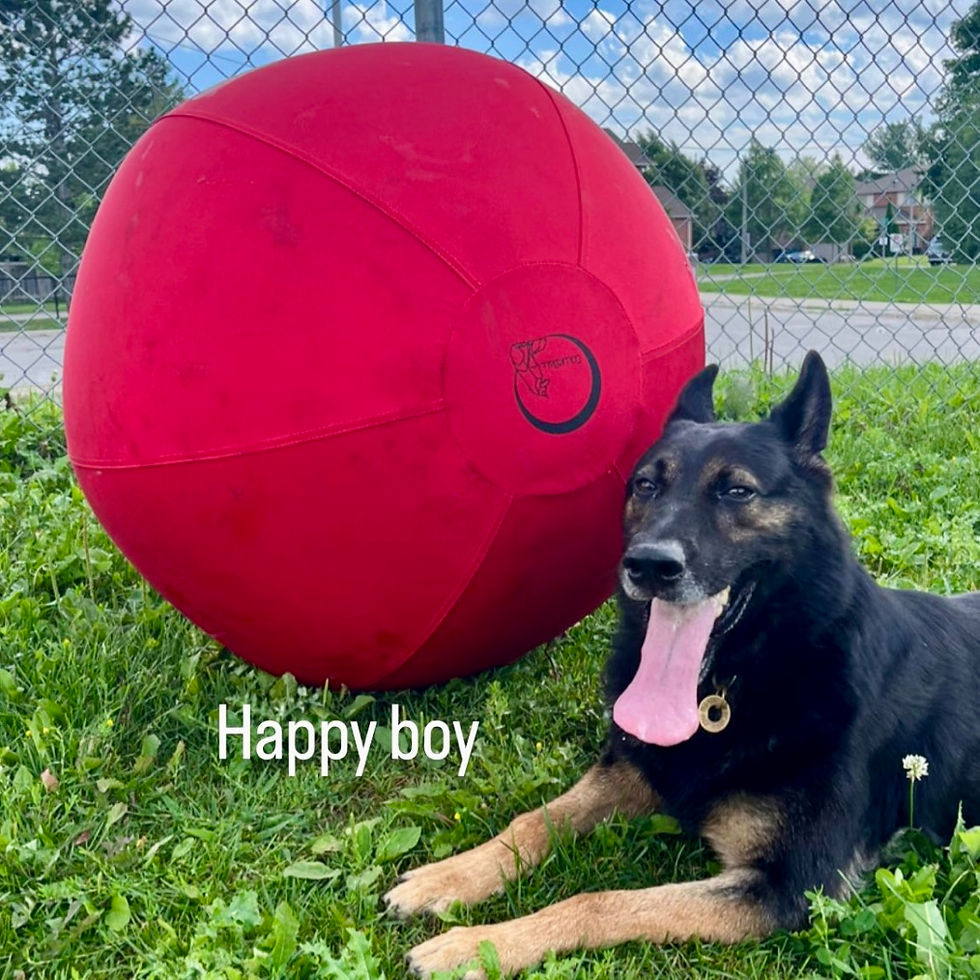
Words only go so far. In this clip an Australian Kelpie drops its shoulder into the ball and resets the chase instead of ending it — the whole point of the format, in a few seconds.
Notice the footwork: the dog reads the roll, cuts the angle, and comes back for more. That's a Kelpie doing the job it was born for, in a suburban backyard.
This second clip leans into the urban angle: a Kelpie in a city setting, turning an ordinary walk into real work. Same instinct, smaller backyard.
What Other Owners Say
CollieBall is rated 4.8 out of 5 stars by 1,265 verified buyers. The words owners repeat most, durable, instinct, and calmer, are exactly what a Kelpie owner wants to see.
→ Read all 1,265 reviews
Common Questions From Kelpie Owners
What size herding ball does a Kelpie need?
Most Australian Kelpies weigh 25 to 45 pounds, which puts them on the 22-inch CollieBall. It's too big to pick up but light enough to push at a sprint. Kelpies over 50 pounds, or those who want a bigger challenge, do well on the 30-inch.
Are herding balls safe for Kelpies?
Yes, when you match the size and supervise play. The ball must be too big for your Kelpie to get its jaws around, which keeps the game to pushing and chasing rather than biting and tearing. Keep it fully inflated and cap sessions at about 15 minutes with water breaks.
Will a working Kelpie destroy a herding ball?
A Kelpie is one of the most relentless testers a toy will ever face, so durability is the whole game. A correctly sized ball sits too high to bite, and a ballistic-fabric cover protects the bladder from claws and teeth. Thin rubber and cheap exercise balls rarely last a week.
Do Kelpies actually like herding balls?
Most take to it fast because it speaks to what they were bred to do. Kelpies muster stock by heading, casting, and pushing, and a ball they can't pick up triggers that same instinct. A few need a day or two of encouragement before the switch flips.
Can a herding ball calm a hyperactive Kelpie?
It can take the edge off. Kelpies pace, nip, and obsess when their working drive has nowhere to go, and pushing a ball burns that energy through the body and brain at once. It isn't a substitute for training, but a tired Kelpie is a far calmer one.
Is a herding ball good for a Kelpie that doesn't have livestock?
That's exactly who it's for. A herding ball gives a stockless Kelpie a daily job in the backyard, channeling generations of mustering instinct into something safe and repeatable. It's the closest most urban or suburban Kelpies get to real work.
The Bottom Line for Kelpie Owners
A Kelpie will out-work almost anything you hand it, so the real question isn't whether a herding ball earns its keep — it's whether the one you buy can take a breed that treats rest as optional. For a standard 25–45 lb Kelpie, that ball is the 22-inch CollieBall at $76.50; for the big station-bred dogs, it's the 30-inch.
Match the size to the build, keep it inflated, and you've finally handed that mustering instinct a job it can't wrap up in three seconds.
→ Grab the 22-inch CollieBall for your Kelpie
→ Compare all four sizes in the lineup


L'impressione generale è che l'argomentazione procede senza digressioni inutili. L'analisi evita di andare oltre i limiti e rimane nell'ambito. Il sito web aiuta a inquadrare il problema nel suo dominio appropriato. I servizi digitali basati su piattaforme aiutano a contestualizzare le tendenze di scala.